How Can We Help?
At AceCo, our technical articles are intended to serve as reference tools—resources that help customers better understand their processes and arrive at solutions that work for their specific applications. Wood machining is influenced by many variables, and while calculations provide guidance, results are always application dependent.
In the precision world of finger jointing, the quality of the finished bond and the efficiency of the production line are governed by two critical, yet distinct, metrics: chip load and knife marks per inch (KMPI). While both describe the interaction between the cutterhead and the wood substrate, they address different technical priorities.
Chip load measures the physical thickness of wood fiber removed by each individual knife, serving as a primary indicator of cutting mechanics, heat dissipation, and tool life. KMPI defines the frequency of knife engagement along the surface of the joint, influencing surface texture and the wood’s readiness for adhesive penetration and consistent mating.
Understanding how these two variables relate—and how they differ—is essential for minimizing fiber damage and ensuring reliable finger joint strength.
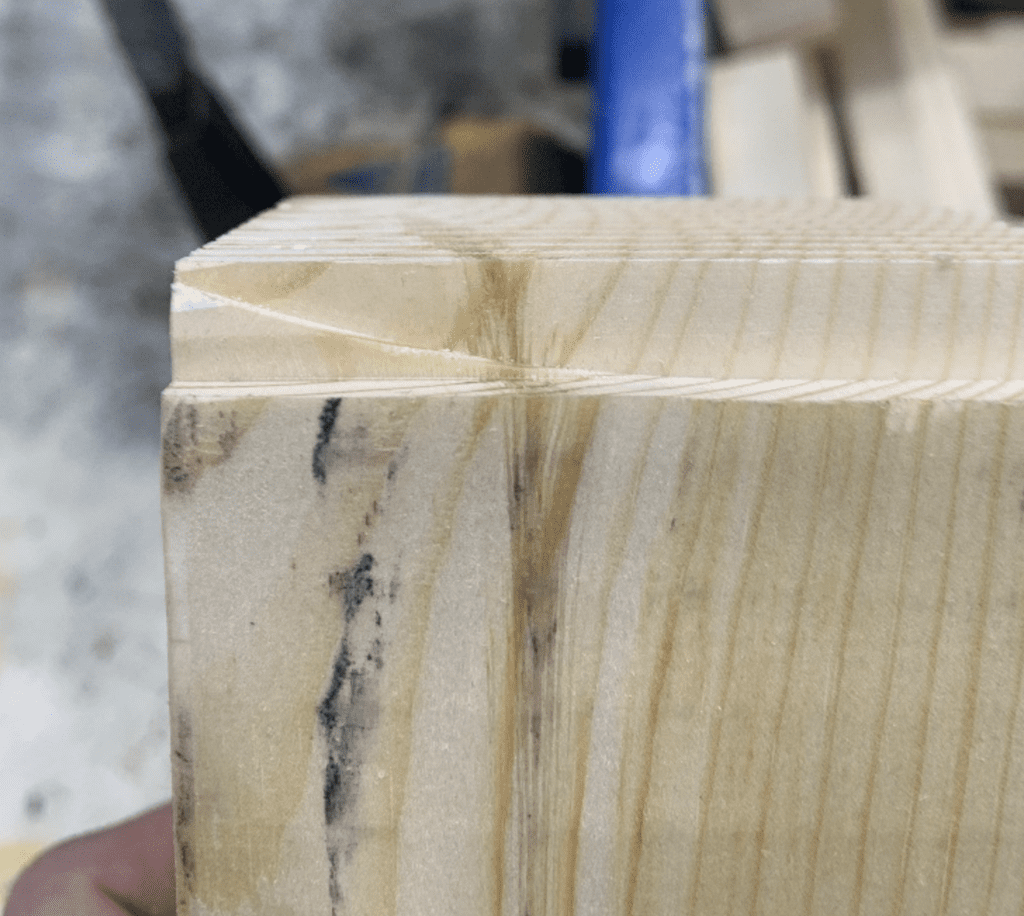
Understanding Chip Load in Finger Joint Tooling
Chip load refers to the thickness of material removed by each cutting edge as the finger profile is machined. In finger jointing, establishing the correct chip load is fundamental to achieving clean cuts, consistent joint geometry, and predictable bond performance.
The Role of the Chip
In finger joint production, the chip serves several critical functions:
- Material Removal: Defines the finger profile geometry and dimensional accuracy.
- Heat Dissipation: Milling generates significant heat at the cutting edge. In an efficient cutting process, a large portion of this heat is carried away by the chip, helping protect both the tooling and the workpiece.
- Mechanical Interaction: Chip formation determines whether fibers are cleanly severed or damaged during cutting.
Finger joint tooling presents unique challenges:
- Cutting occurs primarily in end grain.
- Grain direction changes rapidly across the profile.
- Thin fingertips are mechanically fragile and prone to damage.
Why Correct Chip Load Is Critical
In finger jointing, chip load directly affects:
- Fiber pull-out and tearing
- Micro-fracturing along glue lines
- Cutter life and profile accuracy
- Glue penetration and bond strength
Maintaining an appropriate chip load helps ensure:
- Clean cutting action without excessive tearing or compression
- Extended tooling life through efficient heat removal
- Stable machining conditions that support consistent production
Factors That Influence Recommended Chip Load
There is no single “correct” chip load for all finger joint applications. The ideal value depends on several interacting variables:
- Tool Type: Circle bits, fixed-wing heads, solid carbide, and carbide-tipped tooling all behave differently under load.
- Wood Species: Density, hardness, resin content, and grain structure influence chip formation.
- Feed Rate: Increasing feed rate generally increases chip load, but must be balanced with spindle speed, number of knives, and pieces processed per cycle.
- Joint Length: Short decorative joints may require smaller chips, while longer structural joints often tolerate or benefit from larger chip removal.
- Wood Moisture Content: Moisture level significantly affects fiber behavior, cutting resistance, and surface response.
Practical Effects of Chip Load
Too Low Chip Load
- Rubbing instead of cutting
- Burnished or polished end grain
- Crushed fibers that resist glue penetration
- Weaker joints despite smooth appearance
Too High Chip Load
- Torn fibers at fingertips
- Feathering or breakout
- Inconsistent finger geometry
- Poor finger-to-finger contact when under press pressure
Understanding Knife Marks Per Inch (KMPI)
Knife marks per inch (KMPI) quantify the number of cutter knife impressions left in the wood per linear inch of feed travel. Traditionally used in planing applications to describe surface finish, KMPI can also be applied as a meaningful metric in finger jointing.
Each knife pass leaves a small scallop in the wood. The number of scallops per inch is determined by:
- Cutterhead RPM
- Number of knives
- Feed rate
KMPI Formula
KMPI = (RPM × Number of Knives) ÷ Feed Rate (inches per minute)
KMPI in Finger Jointing
In finger jointing, KMPI is best understood as a glue-surface engineering variable, not a cosmetic one.
KMPI influences:
- Micro-texture of finger faces
- Glue wetting and penetration
- Consistency of finger mating under pressure
Unlike planing:
- Finger joint surfaces should not be glass smooth
- Controlled micro-texture improves adhesive performance
- KMPI affects joint repeatability more than appearance
Practical Effects of KMPI
Too Low KMPI
- Rough finger faces
- Localized tear-out
- Gaps at finger shoulders
- Reduced effective glue area
Too High KMPI
- Polished or burnished surfaces
- Glue starvation
- Slippage during press closing
- Increased sensitivity to adhesive viscosity
Why Chip Load and KMPI Must Be Considered Together
Finger jointing prioritizes bond strength and consistency, with appearance as a secondary concern. The knife must:
- Generate an accurate finger profile
- Create a surface condition suitable for reliable adhesive bonding
The goal is not the smoothest surface, but cleanly severed fibers that accept glue predictably. Overly smooth joints created through improper cutting mechanics may reduce bond strength.
Different wood species, densities, resin contents, and moisture levels respond differently to cutting and adhesive interaction. As a result, the ideal balance between chip load and KMPI is application specific.
Key Insight: The Relationship Between Chip Load and KMPI
Chip load and KMPI are mathematically related and often inversely adjusted—but they control different outcomes.
- Chip load governs how fibers are cut
- KMPI governs how the surface interacts with glue
In finger jointing, it is critical to:
- Maintain a minimum chip load that ensures true cutting action
- Stay within a KMPI range that promotes adhesive wetting without burnishing
Optimizing finger jointing is not about chasing the smoothest surface, it is about producing a repeatable, bond-ready surface through correct cutting mechanic
Conclusion
Maintaining the correct chip load in finger joint tooling is fundamental to producing strong, reliable joints. When chip load is properly matched to the material and application, fibers are cleanly severed rather than crushed or torn, resulting in improved bonding performance, consistent cut quality, and extended tool life.
However, finger jointing is both a science and an art. While chip load, KMPI, and cutting speed can be calculated, real-world results are influenced by factors formulas cannot fully capture—machine condition, spindle stability, tooling geometry, sharpness, alignment, material variability, and overall setup.
For this reason, cut quality should never be evaluated by chip load alone. The best results come from combining calculated parameters with observation, testing, and thoughtful adjustment. When sound cutting mechanics are paired with a stable machine and disciplined setup, finger joint tooling delivers not just clean cuts—but joints that perform reliably over time.
For Chipload/KMPI Calculator, visit: https://aceco.com/knowledge-base/chipload-calculator/